The Forge 2717

Unfinished

Unfinished

The Book of Haggai

Haggai 1–2

History · Prophecy

CreatedJune 21, 2026
Last UpdatedJuly 2, 2026

Author

Haggai — A post-exilic prophet, likely an older man who may have seen Solomon's Temple before its destruction. His name means "festive" or "festival of the Lord," and he is one of the few Old Testament prophets whose message produced immediate, documented results.

Date Written

520 BC — The book is precisely dated by internal evidence to the second year of King Darius I of Persia, between August and December 520 BC, making it one of the most precisely dateable books in the Old Testament.

Recipients

The Jewish remnant who had returned to Jerusalem from Babylonian exile, specifically addressed to Zerubbabel the governor and Joshua the high priest, along with the people of Judah who had stalled in rebuilding the Temple.

Timeline

516 BC

Temple Completed Under Zerubbabel

The Second Temple is completed and dedicated four years after Haggai's ministry reignited the work (Ezra 6:14-15)

520 BC

Haggai's First Oracle

August 29, 520 BC — Haggai delivers his first message challenging the people's priorities (Haggai 1:1-11)

520 BC

The People Obey & Work Resumes

September 21, 520 BC — The leaders and people respond to Haggai's message and resume Temple construction (Haggai 1:12-15)

520 BC

Haggai's Second Oracle — The Glory of the House

October 17, 520 BC — God encourages the workers as older men mourn the Temple's diminished appearance (Haggai 2:1-9)

520 BC

Haggai's Third & Fourth Oracles

December 18, 520 BC — Two final oracles: one on holiness and blessing (Haggai 2:10-19), one on Zerubbabel as God's signet ring (Haggai 2:20-23)

522–520 BC

Darius I Consolidates Persian Power

Following political turmoil after Cambyses II, Darius I secures the Persian throne — stabilizing the empire and creating conditions for renewed construction

536 BC

Temple Foundation Laid

The altar is rebuilt and the Temple foundation is laid, but opposition and discouragement soon halt the work (Ezra 3:1-13)

536–520 BC

Construction Halted by Opposition

Local opposition, including formal complaints to Persian officials, causes the Temple rebuilding to stop entirely (Ezra 4:1-5, 24)

537 BC

First Return of Exiles Under Zerubbabel

A remnant of roughly 50,000 Jews returns to Jerusalem under Zerubbabel and Joshua (Ezra 2:64-65)

538 BC

Cyrus the Great Issues Return Decree

Cyrus of Persia decrees that Jewish exiles may return to Jerusalem and rebuild the Temple (Ezra 1:1-4)

586 BC

Fall of Jerusalem & Temple Destruction

Nebuchadnezzar destroys Solomon's Temple and takes Judah into Babylonian exile

Historical Background

In 538 BC, Cyrus the Great issued a decree allowing Jewish exiles to return to their homeland and rebuild the Temple in Jerusalem. A remnant made the journey back — but nearly two decades later, the Temple still sat unfinished. Haggai steps onto the scene in 520 BC with a direct word from God: the stalling is over.
  • Political Climate: Darius I had recently consolidated power after a period of political instability following the death of Cambyses II. The empire was stable enough for the returned exiles to work, but local opposition — particularly from the Samaritans — had pressured them into stopping construction years earlier (Ezra 4:1-5, Ezra 4:24).
  • The Returned Remnant: The exiles who returned were not the same generation that was taken captive. Most who came back had been born in Babylon. They were reconnecting with a homeland they had never known — with a Temple they had only heard about.
  • Economic Hardship: The people were struggling. Crops were failing, wages weren't stretching, and nothing seemed to be working out. Haggai explicitly connects their economic suffering to their misplaced priorities — God's house lay in ruins while they built paneled houses for themselves (Haggai 1:4-6, Haggai 1:9-11).
  • Local Opposition: Earlier opposition from surrounding peoples had caused the initial halt to construction (Ezra 4). By 520 BC, that opposition was still a factor but the real problem had become spiritual — the people had simply grown comfortable with the status quo.
  • Zerubbabel and Joshua: The civil and religious leaders are named directly. Zerubbabel was a descendant of David, making him a significant figure in the messianic line. Joshua was the high priest. Haggai addresses them by name — the leaders are accountable first.
Understanding this background matters because Haggai isn't speaking to a people in rebellion — he's speaking to a people in drift. They hadn't abandoned God; they had just quietly deprioritized His house. That's a sharper conviction for most men reading this today.

Overall Theme

Haggai's singular message is this: misplaced priorities produce empty lives, and obedience to God's call produces His presence and blessing. The book confronts a people who had put their own comfort and security ahead of God's house — and shows what happens when they repent and get back to work. At its core, Haggai is about the relationship between seeking God first and experiencing His provision, a theme that finds its ultimate fulfillment in the words of Jesus in Matthew 6:33.

Purpose

Haggai wrote to call the returned exiles back to the unfinished work of rebuilding the Temple — and to do it urgently, with specific dates, named leaders, and a direct indictment of their misplaced priorities. But his purpose was never merely architectural. The Temple was the visible symbol of God's presence among His people. To leave it unfinished was to declare — in stone and silence — that God's dwelling among them was not the priority. Haggai's purpose was to expose that drift and reignite both obedience and expectation.

Book Outline

  1. First Oracle: The Call to Build Haggai 1:1–11
  2. Second Oracle: The People Respond Haggai 1:12–15
  3. Third Oracle: The Glory of the Latter House Haggai 2:1–9
  4. Fourth Oracle: Holiness, Discipline, and Blessing Haggai 2:10–19
  5. Fifth Oracle: Zerubbabel the Signet Ring Haggai 2:20–23

Key Themes

Misplaced Priorities

The people of Judah were working hard — just not on the right thing. They were building paneled houses for themselves while God's house sat in ruins. Haggai's repeated phrase "Consider your ways" (1:5, 7; 2:15, 18) is a call to self-examination — to look at where time, energy, and resources are going and ask whether God is truly first.

Haggai 1:2–4Haggai 1:5–7Haggai 1:9

The Presence of God

The Temple wasn't just a building — it was the place where God's presence dwelt among His people. The urgency to rebuild is inseparable from the urgency to restore that dwelling. God's promise "I am with you" (1:13; 2:4) is the anchor of the entire book — the work matters because His presence is the reward.

Haggai 1:13Haggai 2:4–5

Obedience and Immediate Response

One of the most remarkable features of Haggai is what happened after he spoke — the people obeyed within 23 days (1:1, 1:15). This book models what it looks like when God's word is received and acted on without prolonged delay. Obedience is not passive agreement; it is mobilized action.

Haggai 1:12–15

God's Discipline Through Circumstances

The economic hardship described in 1:6 and 1:10-11 was not random — it was God's disciplining hand redirecting His people's attention. Haggai makes the connection explicit: their labor wasn't yielding fruit because they had their priorities backwards. God uses circumstances to call His people back.

Haggai 1:6Haggai 1:9–11Haggai 2:16–17

Courage in the Face of Discouragement

When the older generation wept because the new Temple was so much less impressive than Solomon's (2:3), God responded not with rebuke but with a command to be strong — three times — and a promise that the latter glory of this house would surpass the former (2:9). Haggai refuses to let discouragement be the last word.

Haggai 2:3–5Haggai 2:9

Messianic Hope and Future Glory

The promise that "the desired of all nations shall come" (2:7) and the declaration of Zerubbabel as God's "signet ring" (2:23) point beyond the immediate historical moment to a coming king and a greater glory. Haggai ends with eschatological expectation — God is not finished.

Haggai 2:6–9Haggai 2:20–23

Key Words

English Word Original Word Language Frequency Theological Significance
LORD of hosts יְהוָה צְבָאוֹת (Yahweh Sabaoth) Hebrew 14 The dominant title for God in Haggai, emphasizing His sovereign authority over all heavenly and earthly powers. Its repeated use frames every oracle — this is not a suggestion from a minor deity but a command from the Commander of heaven's armies.
House בַּיִת (bayit) Hebrew 12 Used for both the Temple and the people's own homes — the contrast between these two uses is the central tension of the book. Whose house is getting built first?
Work / Build מְלָאכָה / בָּנָה (melakah / banah) Hebrew 8 The language of active construction runs throughout the book — God commands building, the people respond by building, and the work becomes the measure of obedience.
Consider שִׂימוּ לְבַבְכֶם (sim levavkem) Hebrew 5 Literally "set your heart upon" — used in the repeated refrain "Consider your ways" (1:5, 7; 2:15, 18). It is a call to active, intentional self-examination, not passive reflection.
Glory כָּבוֹד (kavod) Hebrew 3 Used for both the glory of Solomon's Temple and the promised greater glory of the rebuilt house. At its root, kavod means weight or substance — God's glory is not decorative; it has presence and consequence.
Strong / Courageous חֲזַק (chazaq) Hebrew 3 God commands Zerubbabel, Joshua, and all the people to "be strong" (2:4) — the same word used to commission Joshua in Joshua 1:6-9. The connection is intentional: this is a new Joshua moment for a new generation.
Shake / Shaking רָעַשׁ (ra'ash) Hebrew 2 God promises to shake the heavens, earth, nations, and sea (2:6-7, 21) — cosmic language for divine intervention that the New Testament book of Hebrews interprets as pointing to the unshakeable kingdom of Christ (Hebrews 12:26-27).
Spirit רוּחַ (ruach) Hebrew 2 God promises that His Spirit remains in their midst (2:5). This echoes the Exodus and the tabernacle, connecting the returned remnant to the great acts of God in Israel's past.
Covenant בְּרִית (berit) Hebrew 1 Referenced in 2:5 as the promise God made when Israel came out of Egypt — the covenant backstory that grounds God's current commands and promises.
Signet Ring חוֹתָם (hotam) Hebrew 1 Used in 2:23 of Zerubbabel — reversing the curse placed on his ancestor Jehoiachin in Jeremiah 22:24. It signals royal authorization and messianic significance.

Canonical Context

Haggai sits at a pivotal hinge in redemptive history. The exile is over, but the restoration is incomplete. The people are back in the land, but God's house is rubble. Haggai speaks into this in-between moment — after the judgment of exile and before the full restoration that the prophets promised. He is one of only three post-exilic prophets (alongside Zechariah and Malachi), and his two chapters carry an outsized theological weight for their brevity.

Where the Book Fits in Redemptive History

  • Haggai comes after the silence of exile and the partial return under Zerubbabel (Ezra 1–3)
  • He ministers alongside Zechariah during the same period (Ezra 5:1-2)
  • His ministry directly leads to the completion of the Second Temple, the setting for much of late Old Testament and early New Testament history

Old Testament Connections

  • The command "be strong" in Haggai 2:4 echoes God's charge to Joshua (Joshua 1:6-9) — Zerubbabel is being commissioned for a new phase, not military but spiritual
  • The economic curse in Haggai 1:6-11 mirrors the covenant curses of Deuteronomy 28:15-68 — God's discipline follows covenant patterns
  • Zerubbabel as God's "signet ring" in Haggai 2:23 directly reverses the curse on Jehoiachin in Jeremiah 22:24 — God is undoing the judgment and pointing forward
  • The promise of God shaking the nations echoes Joel 3:16 and Isaiah 13:13 — Haggai is drawing from a deep prophetic tradition

New Testament Connections

  • Hebrews 12:26-27 directly quotes Haggai 2:6, interpreting the "shaking" as pointing to the unshakeable kingdom of Christ
  • The "desired of all nations" language in Haggai 2:7 has long been read messianically — Christ is the one for whom all nations ultimately long
  • Zerubbabel appears in the genealogies of both Matthew 1:12-13 and Luke 3:27, firmly placing him in the messianic line that leads to Jesus

Messianic Prophecies

  • Haggai 2:7 — "the desired of all nations shall come, and I will fill this house with glory" — points to Christ as the one who brings God's true glory into the temple
  • Haggai 2:23 — Zerubbabel as signet ring — prefigures the coming King from David's line who will be God's chosen, authorized representative on earth

The book ultimately points to Christ as the one who is both the true Temple (John 2:19-21) and the one in whom the fullness of God's glory dwells bodily (Colossians 2:9). What Haggai could only point to in stones and timber, Christ fulfilled in flesh.
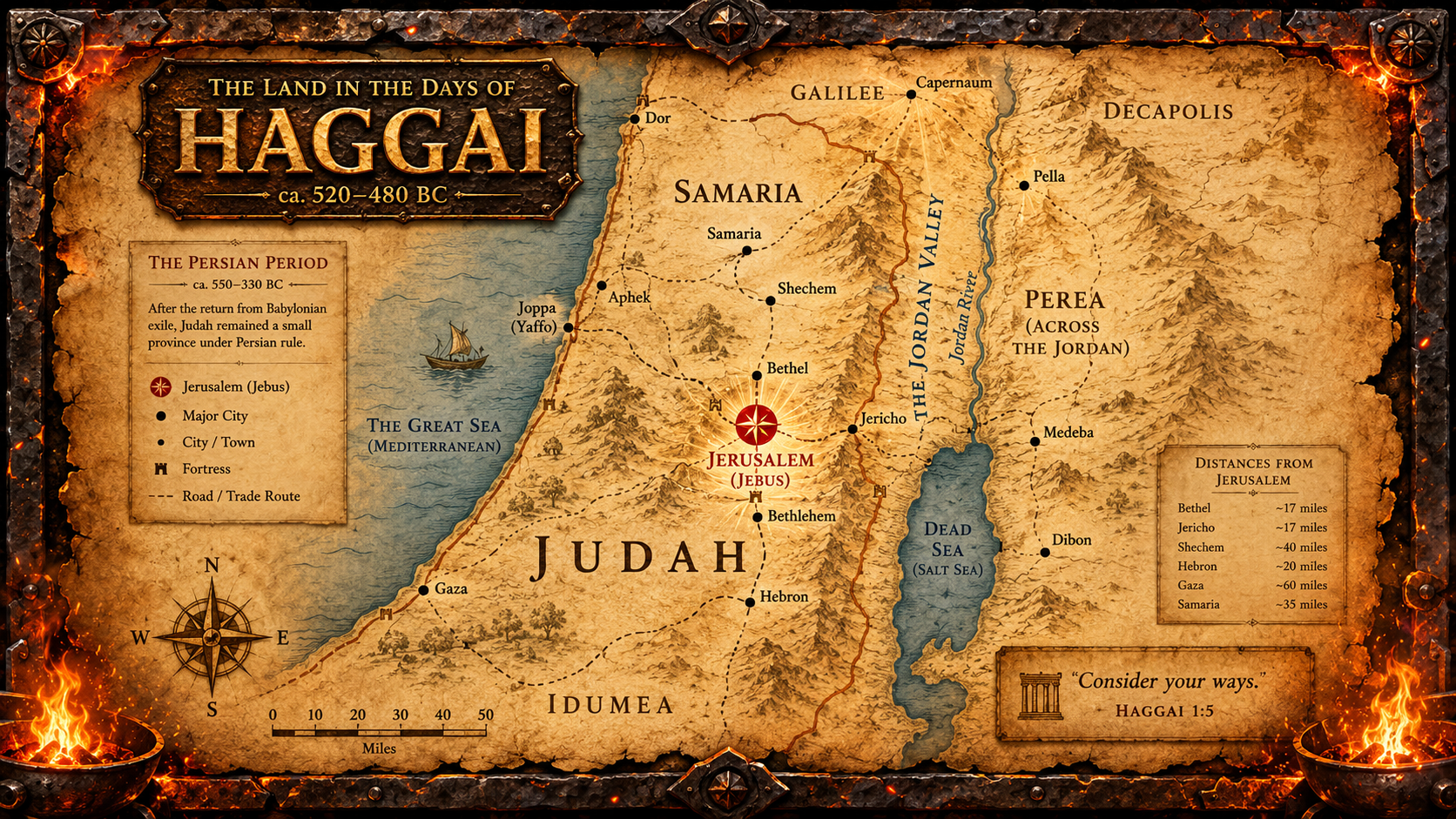
Locations

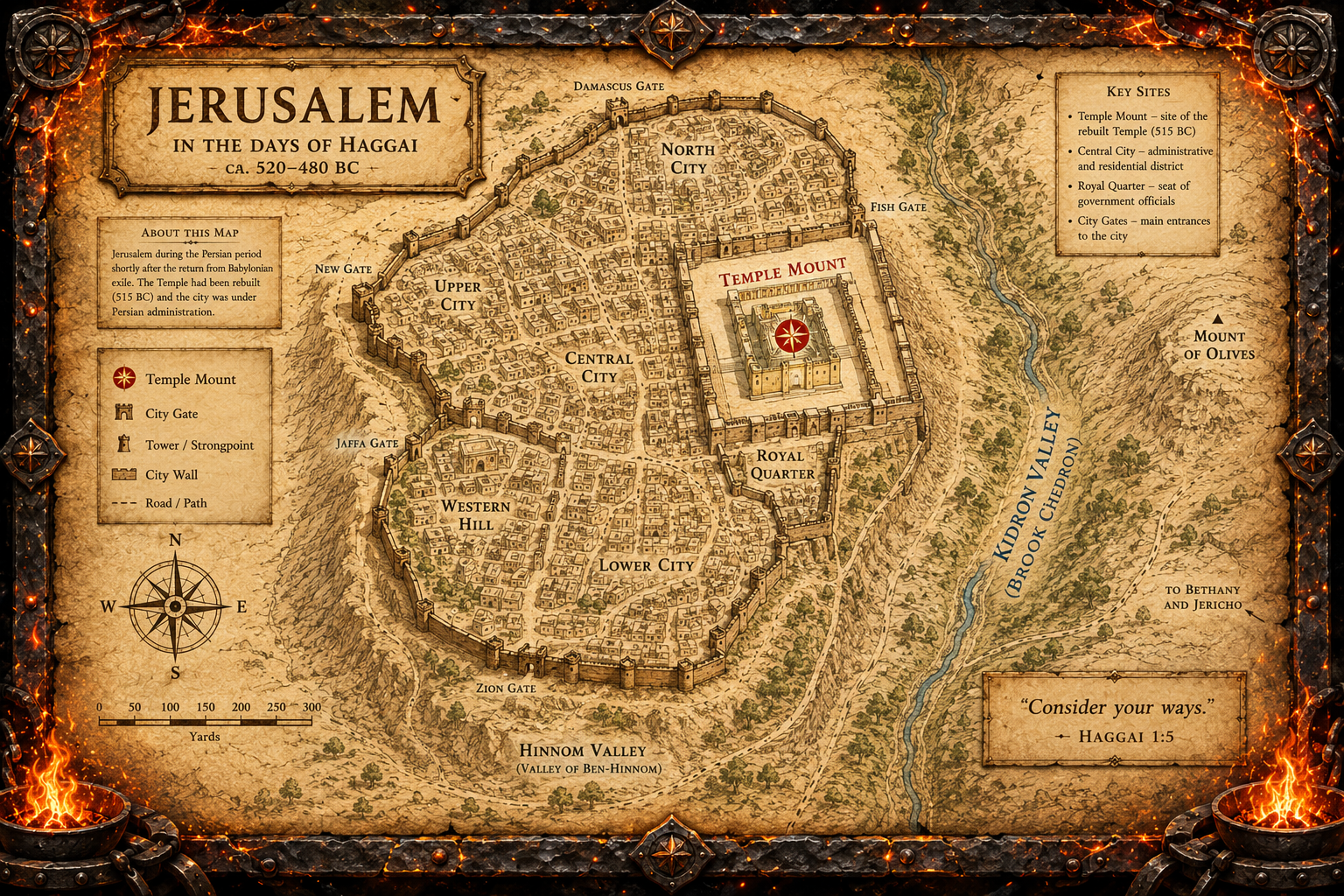
Jerusalem

Jerusalem

Jerusalem is the central location of the entire book of Haggai. It is the city to which the exiles returned, the site of the ruined Temple, and the place where all four of Haggai's oracles are delivered. The rebuilding of Jerusalem's Temple is the singular call of the book.
Haggai 1:1Haggai 1:2Haggai 1:4Haggai 1:8Haggai 2:1Haggai 2:2Haggai 2:10Haggai 2:18Haggai 2:20
The Temple Mount (Mount Moriah)

The Temple Mount (Mount Moriah)

The Temple Mount is the specific site Haggai addresses — the place where Solomon's Temple once stood and where the returned exiles were called to rebuild. It is the physical and theological center of the book. The people's failure to build here is the indictment; the command to build here is the call to obedience.
Haggai 1:2Haggai 1:4Haggai 1:8Haggai 1:14Haggai 2:3Haggai 2:7Haggai 2:9Haggai 2:15Haggai 2:18
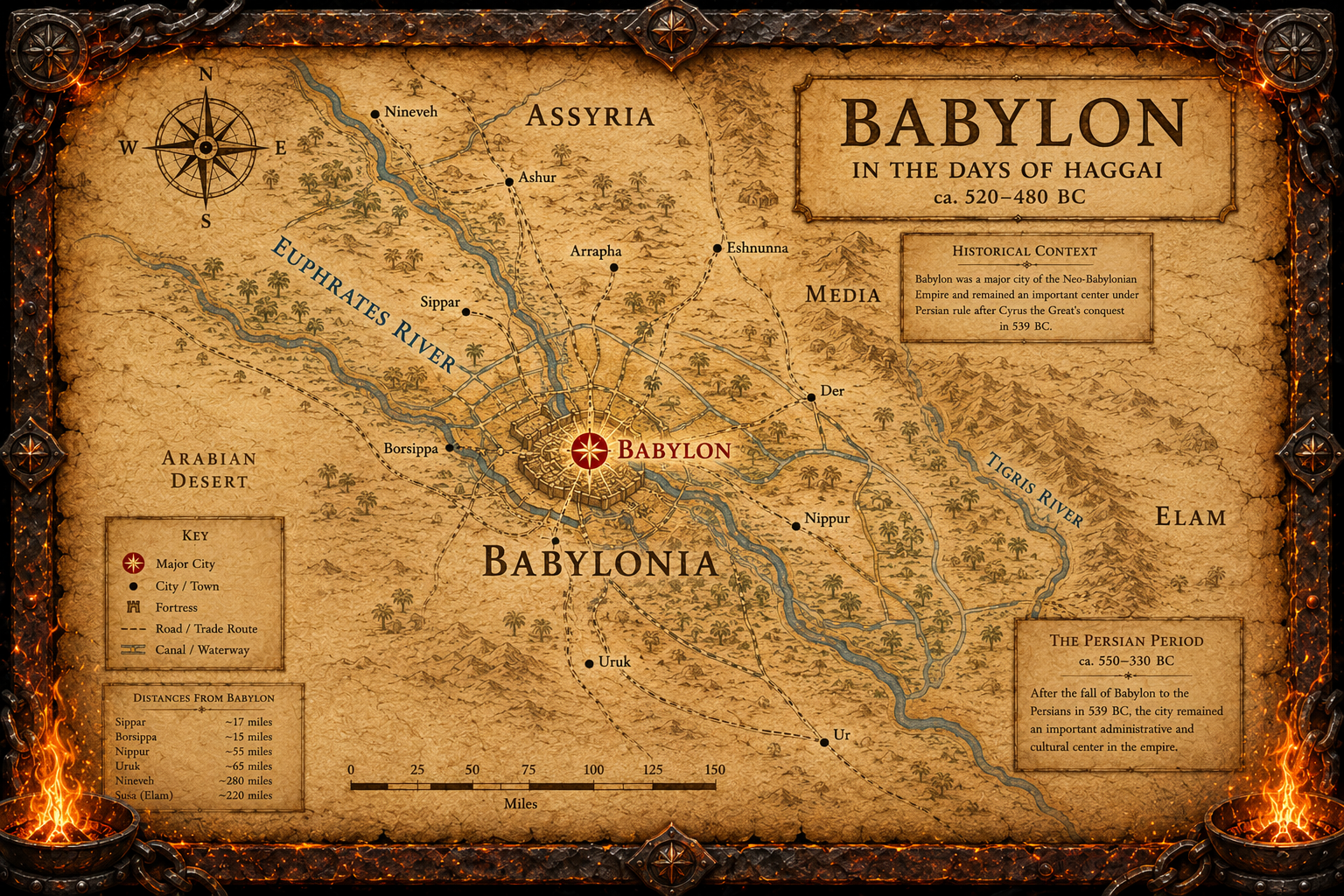
Babylon

Babylon

Babylon is the city of exile from which the returned remnant came. While not explicitly named in Haggai's oracles, it is the defining backdrop of the entire book — the place these men had lived for decades before returning to rebuild. Understanding what they left behind and what they returned to shapes the entire emotional and theological weight of Haggai's message.
Haggai 1:1Haggai 2:2Ezra 1:1Ezra 2:1
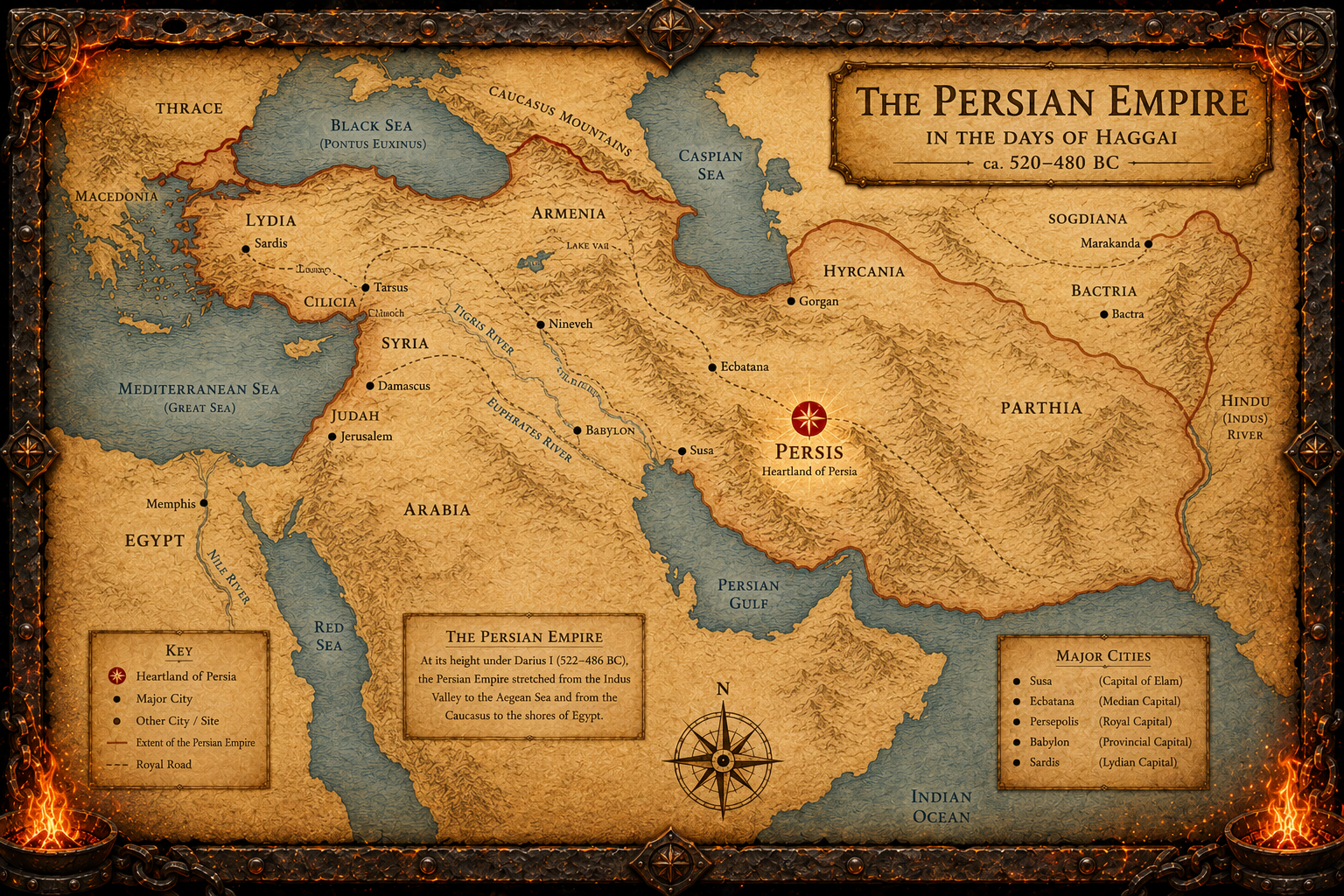
Persia (Susa / Ecbatana)

Persia (Susa / Ecbatana)

The Persian Empire under Darius I is the political world in which Haggai ministers. Darius's decree allowing construction to continue is the political backdrop that makes the resumed building possible. Haggai's oracle begins by dating itself to "the second year of Darius the king" — the Persian ruler's calendar frames the entire book.
Haggai 1:1Haggai 1:15Haggai 2:1Haggai 2:10Haggai 2:20

Common Misinterpretations

"The Latter Glory" Promise Is About Church Buildings or Institutional Success
Common Misinterpretation
Haggai 2:9 — "The latter glory of this house shall be greater than the former" — has frequently been applied to church building campaigns, ministry growth, or institutional expansion. The logic goes: if you give to build God's house, God will bless it with greater glory than anything that came before. This interpretation shows up in prosperity-adjacent teaching and in well-meaning capital campaigns alike.
Correct Interpretation
The promise in 2:9 is not a blank check for church buildings. In its immediate context, God is encouraging a discouraged group of workers who feel the rebuilt Temple will never match the glory of Solomon's. The "latter glory" is not primarily about architecture — it is about presence. The very next line confirms this: "in this place I will give peace." The greater glory is the presence of the Messiah in the Temple itself. This is confirmed by the New Testament: Jesus entered this very Temple, and in Him the fullness of God's glory dwelt bodily (Colossians 2:9; John 1:14). Hebrews 12:26-27 also applies the "shaking" language to the new covenant era, not to building programs. The passage is Christological, not institutional.
Haggai 2:6–9John 1:14Colossians 2:9Hebrews 12:26–27Malachi 3:1
Haggai Teaches a Prosperity Gospel Principle
Common Misinterpretation
Because Haggai connects economic hardship to disobedience (1:6-11) and promises blessing after the work resumes (2:18-19), some teachers have used this book to argue that obedience to God — especially financial giving toward ministry — guarantees material blessing. The formula becomes: give to God's house → God fills your barns.
Correct Interpretation
Haggai's connection between obedience and blessing is covenant theology, not prosperity theology. The curses of 1:6-11 directly mirror the covenant curses of Deuteronomy 28 — this is God's disciplinary hand within a covenant relationship, not a spiritual vending machine. The blessing promised in 2:19 is tied specifically to the resumption of obedience, not to a financial transaction. Furthermore, the primary blessing throughout the book is not material prosperity but divine presence — "I am with you" (1:13; 2:4) is always the greater gift. The book also ends not with barns full of grain but with a messianic promise about God overthrowing kingdoms (2:20-23). Reducing Haggai to a giving formula strips it of its covenantal and eschatological depth.
Haggai 1:6–11Haggai 2:18–19Deuteronomy 28:15–68Haggai 1:13Haggai 2:4Matthew 6:33
"Consider Your Ways" Is a General Self-Help Principle
Common Misinterpretation
The phrase "Consider your ways" (1:5, 7; 2:15, 18) is sometimes lifted out of context and applied as a general call to personal reflection, life audit, or self-improvement. In popular Christian writing and speaking, it has been used to mean: step back, assess your life, make better choices.
Correct Interpretation
"Consider your ways" in Haggai is not a general invitation to self-reflection — it is a covenant indictment with a specific application. The Hebrew phrase literally means "set your heart upon your ways" and in every instance in Haggai, it is immediately followed by a specific charge: you are earning wages but they aren't enough; you are eating but not satisfied; the house of the Lord is in ruins while you build your own. The phrase is a prosecutorial call to see that God's priorities and their priorities are out of alignment. It is also connected in 2:15 and 2:18 to a specific date — "consider from this day onward." The call is not introspective navel-gazing; it is a summons to covenant accountability with an urgent timetable.
Haggai 1:5–7Haggai 1:9–11Haggai 2:15–19Deuteronomy 6:5

Why It Matters Today

Haggai is two chapters long. It took about four months to deliver. And within those four months, an entire people went from stalled to building, from drift to obedience, from empty harvests to the promise of blessing. No other prophetic book in the Old Testament documents this kind of immediate, documented response to a prophetic word. That alone makes Haggai worth a careful read.
  • Drift is more dangerous than rebellion. The returned exiles hadn't walked away from God — they'd just quietly let their comfort take priority over His call. That's the condition Haggai diagnoses, and it's exactly where most men find themselves. Not in outright rebellion, but in a slow, comfortable drift away from what God has called them to build (Haggai 1:2-4).
  • Your circumstances are telling you something. When nothing seems to be working — the job, the finances, the relationships — Haggai insists that God may be speaking through those circumstances. Not always, but the question is worth asking: is there something I've been putting off that God has called me to? (Haggai 1:5-7)
  • The antidote to discouragement is obedience, not comparison. The older generation looked at the new Temple and wept because it wasn't Solomon's. God didn't validate the comparison — He commanded them to be strong and get back to work. Men who are always measuring their effort against someone else's legacy will never build what they're called to build (Haggai 2:3-5).
  • God's presence is always the greater promise. "I am with you" (Haggai 1:13) comes before any promise of material blessing. The men of Judah needed to hear that the work they were doing mattered — not because of what they'd build but because God would be in it. That promise still holds for men who are building families, leading marriages, raising children, and serving their communities in the name of Christ.
  • Obedience has a start date. Haggai gives precise dates. The first oracle is delivered on a specific day. The people respond within 23 days. The blessing is counted from a specific day. Haggai doesn't do vague spiritual impressions — he does dated, documented, concrete obedience. Men who keep saying "soon" about the things God has called them to need this book (Haggai 1:1, Haggai 1:15, Haggai 2:18-19).
  • The kingdom is bigger than your building project. The book ends not with a completed Temple but with God promising to shake nations and establish Zerubbabel as His signet ring. Whatever you're building matters eternally — but it is part of something far larger than your lifetime. Haggai calls men to work with that perspective, knowing the God who is with them is the same God who rules history (Haggai 2:20-23).
Haggai's call is simple and non-negotiable: consider your ways, stop making excuses, and get back to the work God has assigned you. The presence of God is the reward. The work is the way into it. No man who reads this book has any excuse to stay on the bench.

Lessons

# Lesson Passage Published
1 From Ruins to Response Haggai 1:1–15 June 19, 2026
2 The Wrong Measuring Stick Haggai 2:1–9 June 29, 2026
3 Dirty Hands, Chosen Man Haggai 2:10–23 July 17, 2026